





The boundaries of the Universe
The Universe appears undefined in its infinite being. Because its edges are so, not well defined to our knowledge. Or not well defined in principle… to understand this, let us consider the astronomical event called GW190521 (Gravitational Wave observed on May 21, 2019). It is a resounding “firework,” a cosmic bang revealed by the three gravitational interferometers LIGO-Hanford, LIGO-Livingstone, and Virgo: a coalescence of two compact “objects,” two Black Holes with a combined mass 150 times that of the Sun [1]. To understand the distance from which this “bang” comes, let us imagine being able to freeze the expansion of the Universe: the distance from which the wave GW190521 originated is then 16 billion light-years (this quantity is called the “luminosity distance”). But a long, long time has passed between its departure and its arrival. And the system of two black holes that produced GW190521 “now” (let’s stop the motion of the cosmos again!) is located approximately 45 billion light-years away. That system is now beyond the reach of any human-generated signal. It lies in a region of existence that is no longer observable.
All of this is the effect of the expansion of the Universe, the key to the cosmological interpretation of the spatial universe we live in. Time is inextricably intertwined with space. Who (or what, in the sense of a chain of events) produced the GW190521 explosion is outside our observable Universe. But we know of its existence.
And since the region of being extends far beyond the edge of the Universe, we have a modern indefinite. An indefinite that imposes itself, due to systems that have sent signals to us but are now no longer contactable due to cosmological expansion. In fact, they are infinitely distant, also due to the (finite) speed of light. Their belonging to being exists in a form that is indefinite for us.
Cosmological expansion confronts us directly with the difference between what is observable and what is (in the sense of what possesses the property of existence). On the one hand, the protagonists of GW190521 are no longer observable to us—so, if they had not collided, we would know nothing of their existence. On the other hand, it is difficult to imagine that they do not possess the property of existence. An immense black hole with a total mass close to 150 solar masses is located in a region of being that is unobservable—but very likely has not ceased to exist for this reason. Indefinite, that is, at a distance that—for phenomenological purposes—is considered infinite.
Another limit of the Universe (as observable) occurs in the vicinity of space-time singularities (black holes), where the curvature of spacetime becomes infinite. Therefore, the singularity must be considered unobservable, outside our Universe. Moreover, any region within the event horizon is not observable (for the Schwarzschild Black Hole, the simplest, with a horizon of 2MG/c2 where G is the universal gravitational constant, c is the speed of light, and M is the mass of the black hole). But let’s note that this (unobservable) singularity exerts a finite influence despite being in a region where space and time are—for us—unobservable. A region that is, in principle, unobservable. Indefinite, and encompassing a point of infinite curvature.
The Block Universe theory offers an interesting and coherent solution to the problem of being, envisioning a Universe that can be traversed through space and time, respecting the law of causality (determined by the speed of light). By traversing both space and time, different regions of the Universe can be explored. To better understand the Block Universe theory, consider two observers, A (located on Earth) and B (located in a galaxy 150 million light-years from Earth). A observes the Covid epidemic on Earth (because it is connected to the planet), while B observes dinosaurs on Earth. But A’s and B’s observations are both valid—for B, the dinosaurs are simultaneous with him, since simultaneity (between two events) in Relativity is equivalent to (these events) being connected by a photon. But an observer “external to the Universe,” that is, an “epistemological” observer, such as a philosopher, can judge everything that happens and “describe” it just as we are doing. Our philosopher friend realizes what A and B see. And he compares them using relativistic transformation laws. Using General Relativity. This philosopher of ours, “external” to the Universe, realizes that the nows of A and B are different: there is not a single instant simultaneous to the Universe.
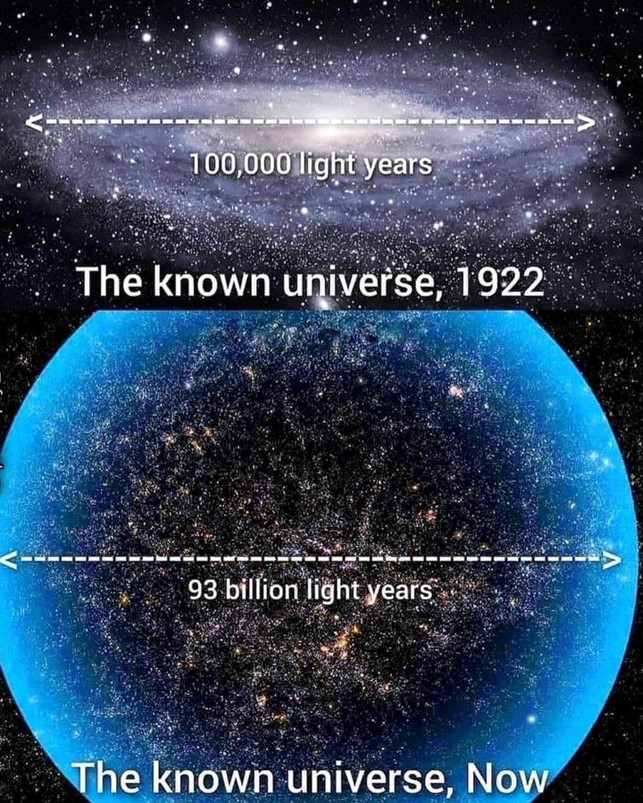
Fig. 1 – On top, the Universe as we knew it at the beginning of the last century. Below, the dimension of the Universe from which we know signals have reached us, starting from the beginning of time.
The Block Universe theory is therefore a vision of Everything in agreement with Relativity. It postulates that past, present and future coexist as parts of an unique unchanging four-dimensional block. The spacetime.
(1) R. Abbott et al., Physical Review Letters 125 (2020) 101102.
Autori: Marco G. Giammarchi e Roberto Radice






















0 commenti